Threshold-Calibrated Word Sense Disambiguation: Semantic Broadening Without Sense Redistribution in Schizophrenia
A sense-tracking study presented at LChange'26 Workshop (EACL) introducing a threshold-calibrated, prototype-based pipeline for tracking word sense prevalence in historical U.S. news articles.
Mar 28, 2026
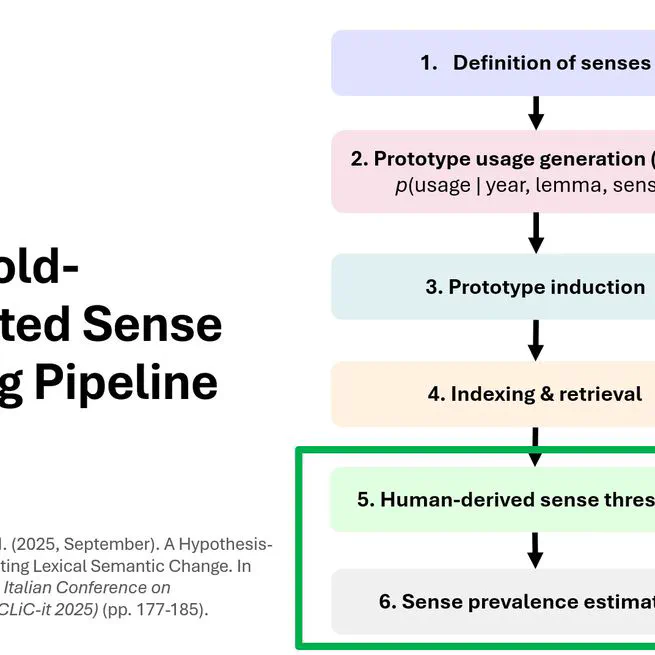
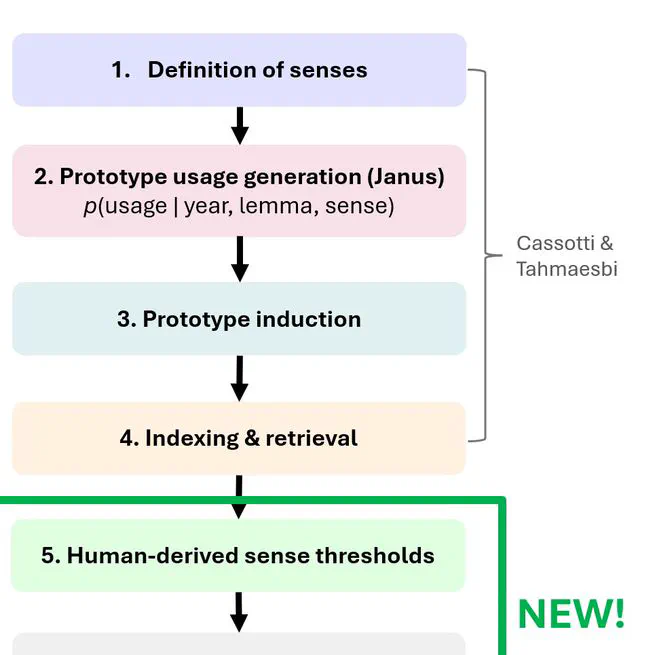
Threshold-Calibrated Sense Tracking Pipeline
A threshold-calibrated, prototype-based pipeline for estimating word sense prevalence in diachronic text corpora. Applied to schizophrenia in historical U.S. news, the pipeline combines sense inventories, generated prototype usages, target-aware embeddings, human-calibrated similarity thresholds, and sense prevalence estimation over time. The repository includes a sample of expert labeled U.S. news sentences (containing the term schizophrenia annotated for which Oxford English Dictionary sense they express).
Mar 28, 2026
Invited Talk - Dimensions of Semantic Change: Validation and Application of the SIBling Framework
An invited talk at the National Research Council Canada on SIBling and LSC-Eval as complementary frameworks for modeling and evaluating semantic change across time.
Sep 24, 2025
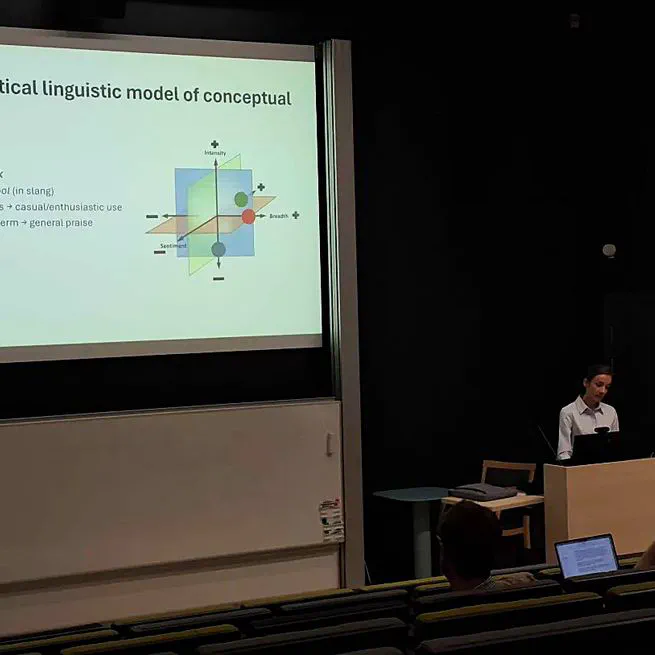
Invited Talk - Dimensions of Semantic Change: Validation and Application of the SIBling Framework
A research talk at Change is Key! Conference (University of Gothenburg, Dept. of Philosophy, Linguistics & Theory of Science) on applying SIBling and LSC-Eval to trace semantic shifts in mental health concepts in historical corpora.
Sep 12, 2025
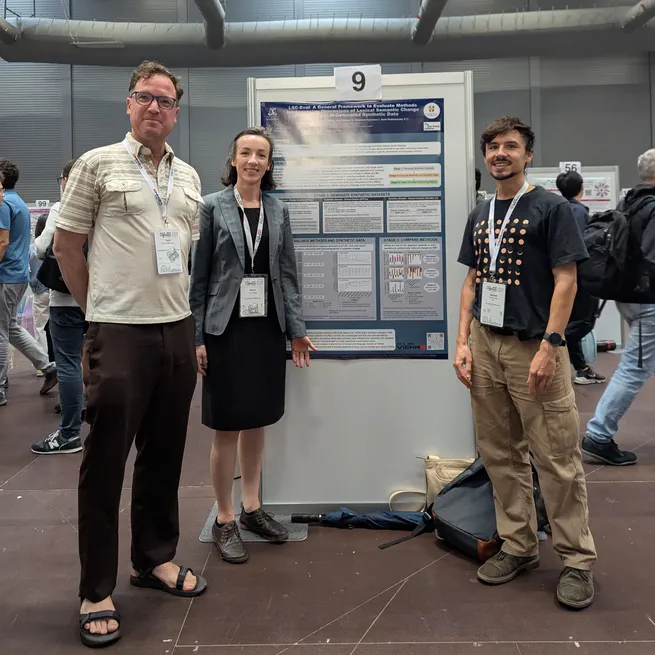
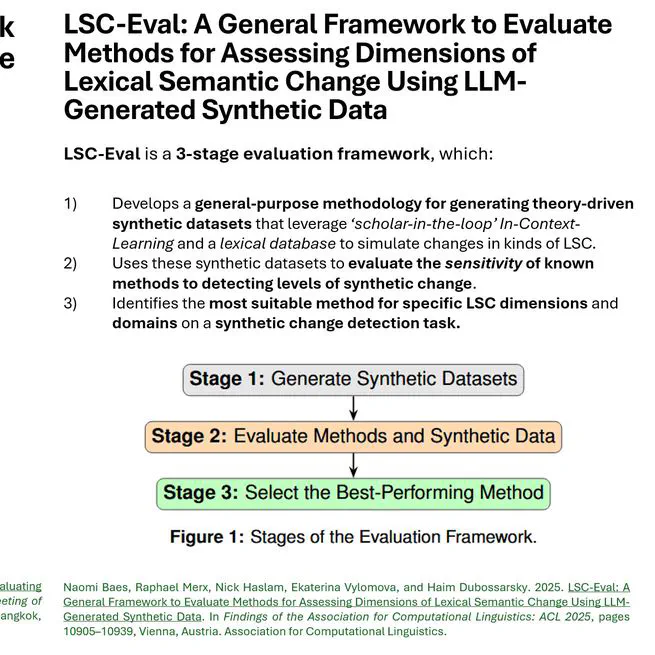
LSC-Eval: A General Framework to Evaluate Methods for Assessing Dimensions of Lexical Semantic Change Using LLM-Generated Synthetic Data
Poster presented at ACL 2025. An evaluation framework that generates historical synthetic benchmark datasets for testing whether semantic change methods are sensitive to detecting the kinds of change they claim to measure.
Jul 28, 2025
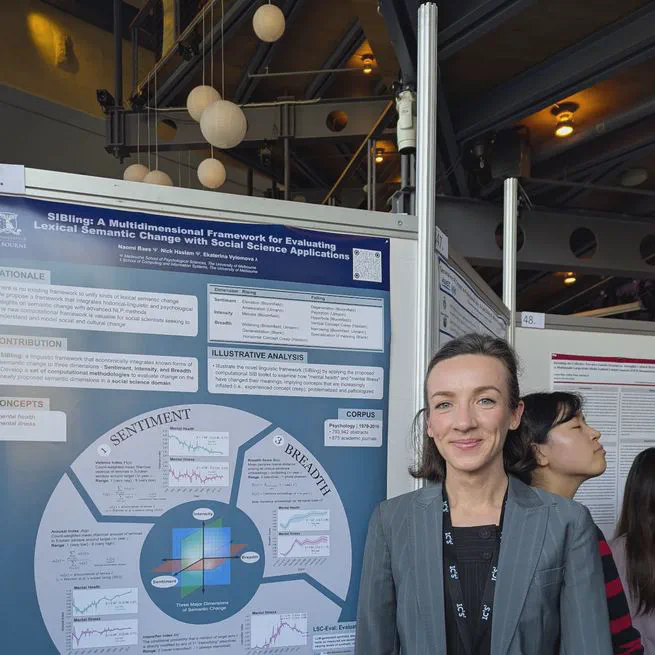
SIBling: A Multidimensional Framework for Evaluating Lexical Semantic Change with Social Science Applications
Poster presented at IC2S2 2025. The paper proposes SIBling, a three-dimensional computational linguistic framework for evaluating lexical semantic change across Sentiment, Intensity, and Breadth, illustrated through an analysis of how 'mental health' and 'mental illness' have shifted in meaning across two corpora.
Jul 2, 2025
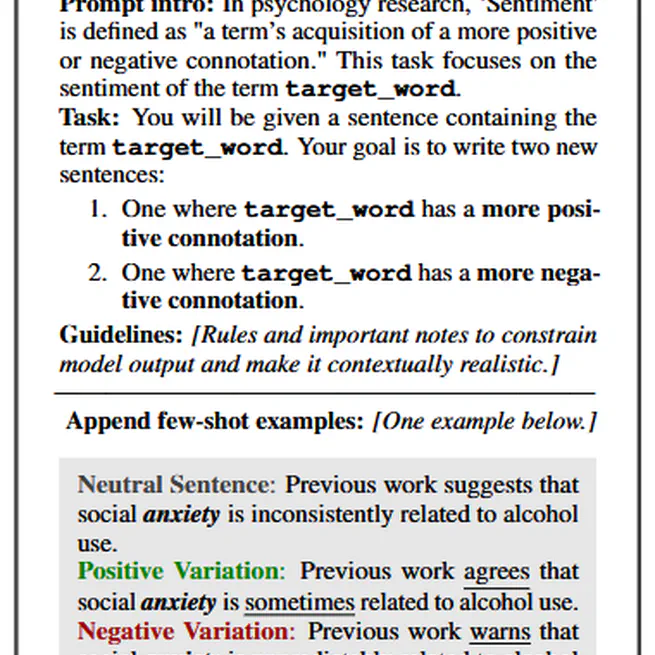
Synthetic-LSC pipeline
Outputs LLM-generated synthetic sentences (‘Scholar-in-the-loop’ In-Context-Learning approach) to simulate dimensions of LSC.
Apr 5, 2025
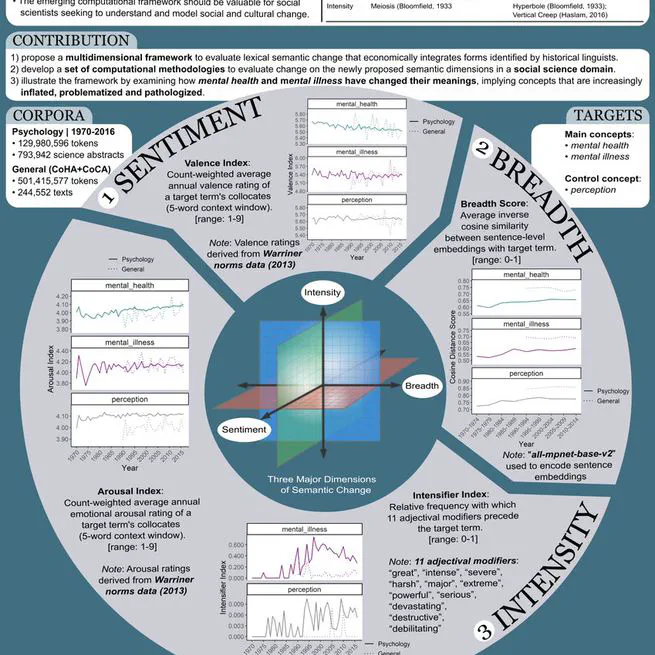
A Multidimensional Framework for Evaluating Lexical Semantic Change with Social Science Applications
The foundational SIBling presentation, introducing a multidimensional framework for modeling lexical semantic change across Sentiment, Intensity, and Breadth.
Aug 14, 2024
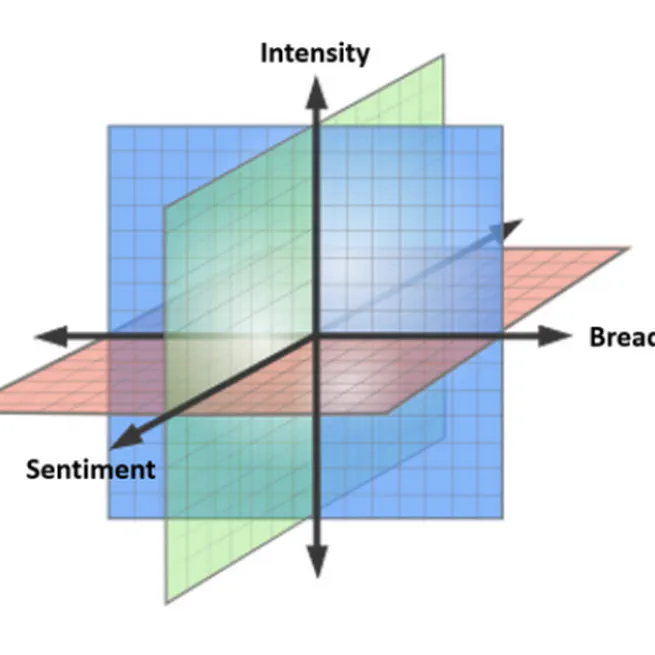
A Multidimensional Framework for Evaluating Lexical Semantic Change with Social Science Applications
A multidimensional framework to evaluate lexical semantic change, for tracing whether words become broader, more emotionally intense, or more positive or negative over time.
Aug 11, 2024
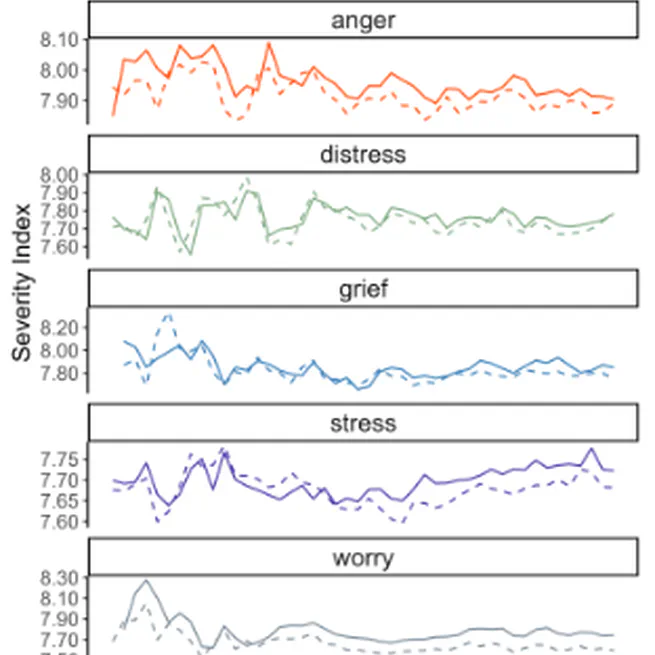
Semantic Shifts in Mental Health-Related Concepts
Link to slides that accompanied my 20-minute Presentation on this paper that was accepted to a workshop - “4th International Workshop on Computational Approaches to Historical Language Change 2023 (LChange ’23)” - on December 6 2023 at Resorts World Convention Centre, Singapore, affiliated with Empirical Methods for Natural Language Processing (EMNLP) 2023 Conference: https://www.slideshare.net/slideshow/semantic-shifts-in-mental-healthrelated-concepts/264396458
Dec 6, 2023