Threshold-Calibrated Word Sense Disambiguation: Semantic Broadening Without Sense Redistribution in Schizophrenia

Abstract
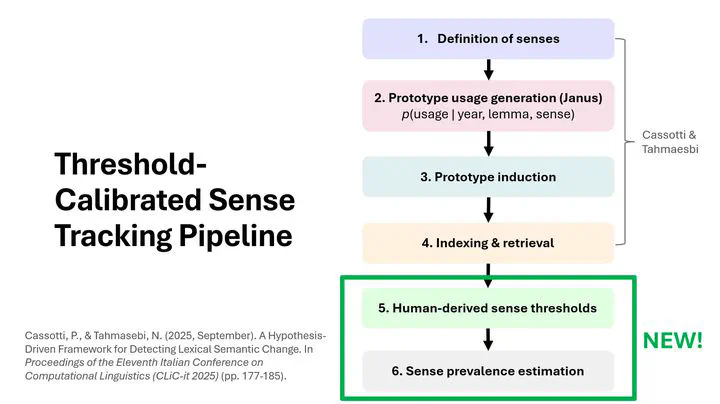
Polysemous words pose a challenge for computational approaches to lexical semantic change. In this work, Nick Haslam and I extend a recent hypothesis-driven, prototype-based framework to estimate word sense prevalence in diachronic text corpora, applying it to 109,940 uses of schizophrenia in U.S. news media from 1985 to 2025. We introduce a threshold-calibrated sense-tracking pipeline with robust prototype construction, contextual breadth measurement, and human-calibrated prototype-similarity thresholds for conservative sense assignment at scale. Although commonly used distributional semantic change metrics show significant increases in breadth and semantic drift, threshold-calibrated sense assignments reveal stable sense proportions: the psychiatric sense remains dominant, while split-personality and metaphorical senses remain marginal. The findings suggest that rising lexical semantic change scores can occur without sense redistribution, reflecting contextual diversification within a stable dominant sense rather than polysemization or sense replacement.
Event
Location
Rabat, Morocco
Rabat,